Wheat varieties grown around the world fall into two categories with different properties: hard wheat and soft wheat.
---
Hard wheat flour is bread flour, it contains more gluten than AP flour.
Soft wheat flour is cake and pastry flour, containing less gluten.
---
Bread flour is milled for bread baking, cake flour for cakes.
Pastry flour for pastry, pie dough and cookies.
---
Remember that all-purpose flour is a blend of flours and all-purpose flour is meant to be an in-between suitable for most baking needs.
Gluten and Chewyness?
Gluten is an important consideration in professional bakeries for cakes, pastry and breads. No one would want a chewy cake or tough cookie, so a lower gluten flour is important. In reverse, crumbly bread that falls to pieces can be avoided when a high gluten flour is used, it also produces the classic chew like that of a baguette. This is a reason why different types of flour are used for different baked items.
Unbleached/Bleached
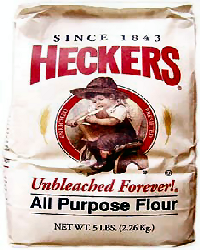
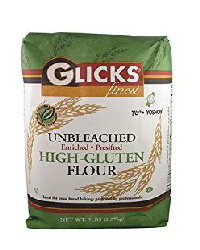
Now consider bleached (no, not with bleach) and unbleached all-purpose flour. Bleached and unbleached, what's the scoop? Bleached flour produces a whiter bread, biscuit or pancake. Bleaching is a chemical process used to make the flour whiter in appearance and to improve its properties. No change occurs in the nutritional value of the flour and no chemical residues remain. Freshly milled flour is not white, but bleaching does not yield results that are as good as aged flour. Aging naturally bleaches the flour through oxygenation and also tends to improve the gluten. Unbleached is natural and has a slight tan tint after milling. Use whatever you like!
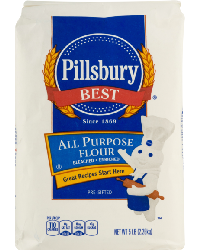
Example---The standard Pillsbury Best All Purpose Flour is
bleached. It is treated with chemical agents to improve
color and baking performance, often labeled as
"Bleached, Enriched". It is a versatile blend of hard
and soft wheat, ideal for cakes, cookies, and breads.
Chemical bleaching of flour is banned in the
European Union and the UK.
Other flours:
Bread Flour.
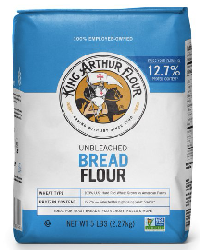
King Arthur Bread flour, is 12.7% protein and is great for breads, pasta and pizza. There are many protein levels depending on the brand with some as high as 13.4% protein. For crustiness and chew it's my first choice. FYI, you can add vital wheat gluten to increase the protein level for even chewier results especially when making bagels. Consider these two commercial bakery flours--- ADM Regal® flour is a professional bread baker's flour. The protein is 14.2%, it has excellent mixing tolerance and excellent absorption properties. Regal is ideal for bagels; Kaiser rolls; thin-crust pizza; and Italian, French and Jewish breads. Another ADM flour is Cavalier® with protein at 14.3%. If you’re looking for a high-protein flour with a slightly darker crumb, its unmatched fermentation tolerance makes it perfectly suited for sourdough and specialty breads.
Pastry Flour---aka. Baking Flour outside the USA
Pastry Flour-Baking Flour comes in at about 9% protein. Professionally and even for home bakers, pastry flour is the way to go for flaky pie dough, Danish pastry and cookies. It absorbs a bit less water so you will get a better blend of ingredients and less toughness. You will also see whole wheat pasty flour in markets, it's okay but I still think the good old white pastry flour is without equal for my pie dough and cookies!
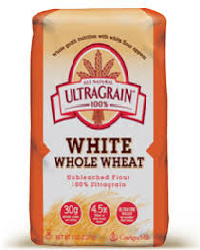
| White Whole Wheat
White Whole Wheat flour, fairly new to the market, is milled the same way as whole-wheat, but using hard white wheat berries instead of red wheat and it has a sweeter flavor. It's a good choice for homemade bread; choose white whole wheat flour instead of all-purpose or combine half and half in your next bread or pizza dough recipe.
Whole Wheat Flour is rich in nutrients and dietary fiber, but it poses some challenges for beginning bakers because it usually absorbs water differently than white flour and may need the addition of gluten to reduce crumbliness. Still it makes wonderful and flavorful health breads.
Self-Rising Flour is a blended mix that combines all-purpose flour, salt and a leavening agent. It is a convenience to have everything already to go if you like making biscuits, pancakes, or cornbread. National brands of self-rising flour to look for are Gold Medal and Pillsbury.
Semolina and Durum Flour Semolina is actually just a type of flour made from durum wheat at 13 to 13.5% protein, it is granular and is coarser than most milled flours. If you make pasta, you’ll definitely need semolina. Don't get confused with cornmeal---it is not the same. In Italy semolina is also used for some breads and to make polenta instead of using cornmeal.
Durum Flour is an unbleached flour left over from the milling process from the hard durum wheat and also a product of semolina that's ground further. Durum flour is used for making pasta, noodles and some specialty breads. If milled coarsely and cooked it is cous-cous and even a delicious breakfast porridge with butter, cream and nutmeg!
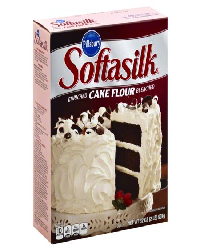
Cake Four, Cakes made with all-purpose flour may have too much gluten, making them tough and dense. Bread made with all-purpose flour may not have enough gluten, making it too fragile. If you are a perfectionist, using cake flour for cakes is recommended. Why? Cake flour contains less protein than all-purpose flour which means it will produce a tenderer product and is also bleached by design. Swans Down and Softasilk cake flour come in at 7.5 to 8.5% protein. Bake cakes, quick breads, muffins and pancakes with it and they will be light with a nice crumb. The next time you bake a cake, you’re going to want to have some cake flour on hand.
There are even more considerations such as pH, ash content and moisture content in flour and they all play a role in professional baking. As a home baker you will most likely only need four types of flour in your kitchen. A good brand of all-purpose, a cake flour, a whole wheat and a bread or high-gluten flour. Depending where you live, your grocery store shelves will have all you need!
|
00 Flour is worthy of mention if you make pizza dough, Scali and Italian bread!
BEWARE---Just because you use
00 flour for pizza
dough doesn't mean your pizza will come out like
pizza in Naples Italy! There are many
considerations; water to flour ratio, amount of
yeast, how much salt is used, the use of a
poolish, fermenting no less that 8 hours and the
temperaure of the oven and it's HOT! A minimum
temperature of 800 degrees F to as much as 1,000
degrees F (426.7–537.8°C) is a standard. On a
recent trip to Napoli a Pizzaoa said that he
likes 825 F (440 C), so the crust doesn't char
too much.
Caputo is a popular brand from Naples, yet there are
many other brands of 00. 00 is just the measure of the milling
fineness in Europe.
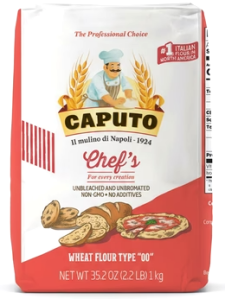
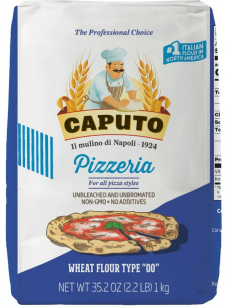
Capouto make two diffrent 00 flours; Chef's Flour
(Red Bag)
and Pizzeria (Blue Bag)---this relates to a general kitchen
use flour and a specific "For Pizza Flour" that's
a brand formula secret for them. 00 flour is a very fine-textured flour a/k/a Italian pizza flour and may also be known as Manitoba flour. It's protein content hovers between
10-12%. It produces a dough that is easy to work with: handles well, is smooth and easy to shape. The resulting baked goods are light, airy, and have a crisp snap to the crust and a nice crumb. It's ideal for focaccia and pasta too albeit a bit expensive.
Capouto is a large company with many brands, from seven types of flour at last count, canned
Italian tomatoes, olives and olive oil, not to
metion buffalo mozarella. Think of it as an
Italian company like General Mills!
European Flour
European flour is primarily classified by its
ash content—the amount of minerals left behind
after the flour is burned—rather than just
protein levels. This system measures how much of
the wheat's outer bran and germ remains, which
determines the flour's refinement, flavor, and
color.
Comparison of Major
European Flour Systems
Different
countries use their own numbering systems, which
can be mapped to roughly equivalent American
varieties.
Usage / Type Italian (Milling)
French (T-Number) German (Mehltype) US
Equivalent
Pastry / Cake Type 00 T45 Type 405
Pastry / Cake Flour
All-Purpose Type 0 T55
Type 550 All-Purpose Flour
Artisan Bread Type
1 T65 Type 812 Bread Flour
Whole Wheat
Integrale T150 Type 1600 Whole Wheat
Country-Specific Highlights
Italy: Classified by the
fineness of the grind from 00 (ultra-fine) to 2
(coarse). Bakers also use the W rating to
measure "strength" or elasticity; for example, a
Caputo Chef’s Flour Tipo 00 often has a high W
rating for long fermentation.
France: The "T" numbers (like T45 or
T55) represent the ash percentage (e.g., T45 has
~0.45% ash). T55 is the standard choice for
traditional baguettes.
Germany:
Numbers indicate milligrams of mineral per 100g
of flour (e.g., Type 405 has 405mg of minerals).
They also have extensive classifications for Rye
(Roggenmehl), such as Type 815 (light) and Type
1150 (dark).
Key Differences from
North American Flour
Wheat
Variety: Europe grows more soft wheat and white
wheat varieties, while North America focuses on
Hard Red Spring/Winter wheats.
Digestibility: Many consumers find European
flour easier to digest because it is often
unbleached, not treated with chemicals like
bromate, and naturally lower in gluten.
Specific Products: Authentic brands like Antimo
Caputo and Anna Flour are gold standards for
specialized tasks like Neapolitan pizza or
pasta.
|